
ARVO 2026
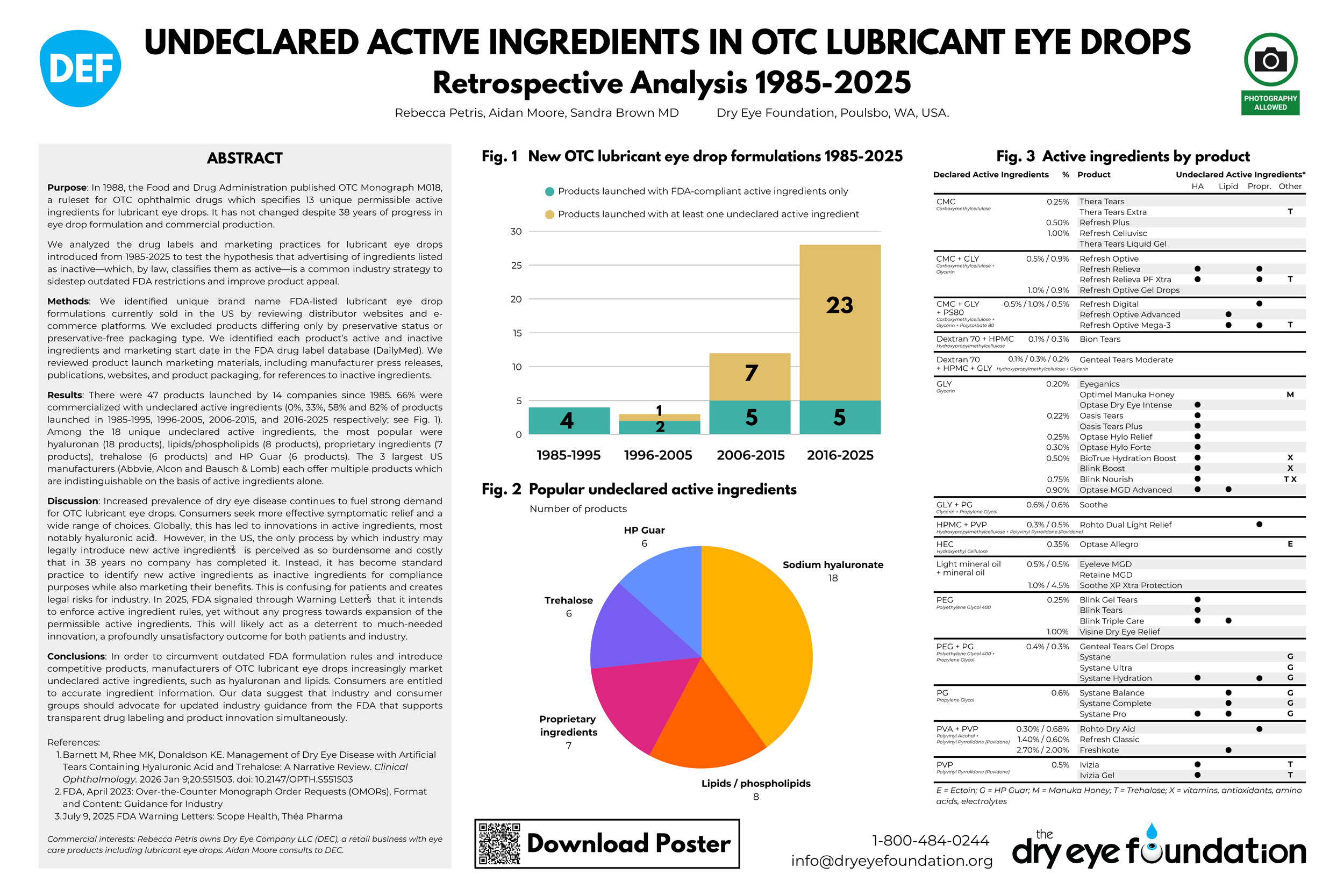
Undeclared Active Ingredients in OTC Lubricant Eye Drops
Retrospective Analysis 1985-2025
ABSTRACT
Purpose: In 1988, the Food and Drug Administration published OTC Monograph M018, a ruleset for OTC ophthalmic drugs which specifies 13 unique permissible active ingredients for lubricant eye drops. It has not changed despite 38 years of progress in eye drop formulation and commercial production. We analyzed the drug labels and marketing practices for lubricant eye drops introduced from 1985-2025 to test the hypothesis that advertising of ingredients listed as inactive—which, by law, classifies them as active—is a common industry strategy to sidestep outdated FDA restrictions and improve product appeal.
Methods: We identified unique brand name FDA-listed lubricant eye drop formulations currently sold in the US by reviewing distributor websites and e-commerce platforms. We excluded products differing only by preservative status or preservative-free packaging type. We identified each product’s active and inactive ingredients and marketing start date in the FDA drug label database (DailyMed). We reviewed product launch marketing materials, including manufacturer press releases, publications, websites, and product packaging, for references to inactive ingredients.
Results: There were 47 products launched by 14 companies since 1985. 66% were commercialized with undeclared active ingredients (0%, 33%, 58% and 82% of products launched in 1985-1995, 1996-2005, 2006-2015, and 2016-2025 respectively; see Fig. 1). Among the 18 unique undeclared active ingredients, the most popular were hyaluronan (18 products), lipids/phospholipids (8 products), proprietary ingredients (7 products), trehalose (6 products) and HP Guar (6 products). The 3 largest US manufacturers (Abbvie, Alcon and Bausch & Lomb) each offer multiple products which are indistinguishable on the basis of active ingredients alone.
Discussion: Increased prevalence of dry eye disease continues to fuel strong demand for OTC lubricant eye drops. Consumers seek more effective symptomatic relief and a wide range of choices. Globally, this has led to innovations in active ingredients, most notably hyaluronic acid.(1) However, in the US, the only process by which industry may legally introduce new active ingredients(2) is perceived as so burdensome and costly that in 38 years no company has completed it. Instead, it has become standard practice to identify new active ingredients as inactive ingredients for compliance purposes while also marketing their benefits. This is confusing for patients and creates legal risks for industry. In 2025, FDA signaled through Warning Letters(3) that it intends to enforce active ingredient rules, yet without any progress towards expansion of the permissible active ingredients. This will likely act as a deterrent to much-needed innovation, a profoundly unsatisfactory outcome for both patients and industry.
Conclusions: In order to circumvent outdated FDA formulation rules and introduce competitive products, manufacturers of OTC lubricant eye drops increasingly market undeclared active ingredients, such as hyaluronan and lipids. Consumers are entitled to accurate ingredient information. Our data suggest that industry and consumer groups should advocate for updated industry guidance from the FDA that supports transparent drug labeling and product innovation simultaneously.
References:
Barnett M, Rhee MK, Donaldson KE. Management of Dry Eye Disease with Artificial Tears Containing Hyaluronic Acid and Trehalose: A Narrative Review. Clinical Ophthalmology. 2026 Jan 9;20:551503. doi: 10.2147/OPTH.S551503
FDA, April 2023: Over-the-Counter Monograph Order Requests (OMORs), Format and Content: Guidance for Industry
July 9, 2025 FDA Warning Letters: Scope Health, Théa Pharma
Commercial interests: Rebecca Petris owns Dry Eye Company LLC (DEC), a retail business with eye care products including lubricant eye drops. Aidan Moore consults to DEC.